Monday, December 07, 2009

Ρους ο κόσμος


Λιζέλ Μύλλερ,
Ο Μονέ αρνείται την επέμβαση


Γιατρέ, λέτε πως δεν υφίσταται άλως
στου Παρισιού τους φανοστάτες ολοτρίγυρα,
πως ό,τι βλέπω είναι διαταραχή,
της γεροντικής ηλικίας κάποιο σύμπτωμα, κάτι λυπηρό βεβαίως.
Όμως τούτο θα σας πω: μου πήρε ολόκληρη ζωή
μέχρι να κατορθώσω να δω τις λάμπες φωταερίου ως αγγέλους
να απαλύνω, να θαμπώσω κι, εντέλει, ν΄αποδιώξω
τα περιγράμματα που δυστυχώς κατ' εσάς δε βλέπω
να μάθω πως η γραμμή που ονόμαζα ορίζοντα
δεν υπάρχει και πως ουράνια και νερό,
μ' όλην τους την απόσταση, είναι ίδια μορφή του όντος.
Πριν πενήντα τέσσερα χρόνια κατάφερα να δω
πως ο Καθεδρικός της Ρουέν ήταν χτισμένος
από παράλληλες ηλιαχτίδες
και τώρα επιθυμείτε να διορθώσετε
της νιότης μου τα λάθη: καθορισμένες
έννοιες του πάνω και του κάτω,
η φρεναπάτη του τρισδιάστατου χώρου,
γλυσίνες ξέχωρες απ' το γεφύρι που καλύπτουν.
Τι θα μπορούσα να σας πω για να σας πείσω
πως η Βουλή των Κοινοτήτων διαλύεται
νύχτα τη νύχτα για να γίνει
του Τάμεση το υγρό όνειρο;
Δε θα πισωδρομήσω σε ένα σύμπαν
όπου τα αντικείμενα αγνοούν το ένα τ' άλλο,
ωσάν τα νησιά να μην είναι τα απολωλότα τέκνα
μιας μεγάλης ηπείρου. Ο κόσμος
είναι ρους και το φως γίνεται ό,τι αγγίζει
γίνεται νερό και κρίνα πάνω στο νερό,
πάνω απ'το νερό κι από κάτω,
γίνεται λιλά και μωβ και κίτρινο
κι άσπρο και λαμπρογάλαζοι φανοί,
μικρές γροθίτσες που περνούν το φως του ήλιου
η μια στην άλλη τόσο γρήγορα
που θα χρειάζονταν μακριές, κυματιστές τρίχες
στο πινέλο μου να το κρατήσουν.
Να ζωγραφίσουν την ταχύτητα φωτός!
Τα βαριά μας σχήματα, αυτά τα κατακόρυφα,
καίγονται να σμίξουν τον αέρα
ν' αλλάξουν τα κόκαλα, το δέρμα και τα ρούχα μας
σε αέρια μορφή. Γιατρέ,
μακάρι να μπορούσατε να δείτε
πώς έλκει την γη ο ουρανός στην αγκαλιά του
και πώς ατέρμονα απλώνει η καρδιά
να πάρει αυτόν τον κόσμο, άπειρο ατμό γαλάζιο.

(Μτφ. Βασίλης Οικονομίδης)

Labels: , , ,

Sunday, October 04, 2009

Νάνι Μερθέντες

Mercedes Sosa- "La Negra" or "The Voice of the Voiceless"- has been an emblematic figure in many aspects.
She had set her firm foundation on the folk musical tradition of her country (Argentina) and became a voice of innovation. She stood by the youth, she supported new artists.
She was politically conscious and a fighter against oppression during the gloomy years of successive dictatorships. She got arrested in 1979 on stage along with people from the audience. Nueva Cancion represented a disturbance: most of genuine art becomes a disturbance.
She died last night in Buenos Aires.
I will miss her face behind her big glasses.
Here is a sample of her collaboration with Maria Farantouri, a lullaby by Manos Hadjidakis and Nikos Gatsos (a translated poem of F.G. Lorca). Her accent is great and the tone is superb.

Labels: , , , ,

Thursday, January 08, 2009

Άνθρωπος πέρασε από εδώ


Ποτέ σου δε θα ξαναδείς
Θάλασσες να καλπάζουν
Νύχτες, ιππότες της Ευχής
Βουνά να σ'αγκαλιάζουν

Ποτέ σου δε θα ξαναδείς
Δάση να σε φωνάζουν
Αστέρια, Μοίρες της Αυγής
Ποτάμια να γιορτάζουν

Άνθρωπος πέρασε από εδώ
Και γέρασε τα μάτια
Στα χείλη έσταξε καημό
Πληγές, Ζωές κομμάτια

Άνθρωπος πέρασε από εδώ
Και τρόμαξε ό,τι ζούσε
Τον κόσμο χώρισε στα δυο
Στο νου του πολεμούσε

Ποτέ σου δε θα ξαναδείς
Μήνες να σε γυμνάζουν
Όνειρα, φώτα της Ακτής
Φεγγάρια να σ'αλλάζουν

Το ποιητικό τραγούδι γράφτηκε από τον Παρασκευά Καρασούλο, μελοποιήθηκε από το Θοδωρή Οικονόμου και τραγουδήθηκε από τη Μαρία Δημητριάδη. Κυκλοφόρησε στους Δον Κιχώτες το 2001, με το όμορφο εξώφυλλο (ακουαρέλες του Ανδρέα Γεωργιάδη- Ναυαγοί σε νυχτωμένη θάλασσα). Χτες και σήμερα νεκρολογούν την ερμηνεύτρια οι εφημερίδες και τα ιστολόγια. Για μένα η φωνή της, όσο μεγάλωνε, γινόταν αποκάλυψη, στου Μιχάλη Τρανουδάκη για παράδειγμα τη Μυθολογία του Σαββάτου, 1985 (ιδιαιτέρως στην Άννα της Αραγωνίας ή στο Χαμάμι του Μουχτάρ Πασά με τους στενόχωρους στίχους του Γ.Χρονά).
Ανησυχώ πού να πηγαίνουν αυτοί οι άνθρωποι που με κουβέντιασαν και με μόρφωσαν με τις φωνές ή τις μουσικές τους. Αλλά και με τις επιλογές τους, την πολιτική τους εγρήγορση και τη διαθεσιμότητά τους προς τους νέους δημιουργούς. Αναρωτιέμαι αν βρίσκουν ένα μικρό κινηματοθέατρο με φαγωμένες βελούδινες καρέκλες, σε ανώνυμη σχεδόν επαρχία στη Χώρα των Σκιών. Το σίγουρο είναι ότι δε με εγκαταλείπουν, μα από καιρού εις καιρόν μου γνέφουν.

Labels: , ,

Sunday, September 21, 2008

Chronophage

Homer was said to be blind, therefore he saw much. The fights and the muddy river, the details on Achilles's shield, the rays of the morning sun and the clothes of Athena while approaching. And Stephen Hawking has been bound on his wheel chair for long years, traveling far, in time, space and the realms in between. He is the one who two days ago unveiled the strangest probably timepiece on Earth of our times at the Corpus Christi College in Cambridge. The unconventional clock was given the Greek name Chronophage (the Time Eater- χρόνος + (έ)φαγ-ον) made of stainless steel and plated with 24-carat gold. There are no hands, or digits for the greedy instrument, nor is accuracy its strong feature. It even falls back several seconds to catch up with the "correct" time every five minutes.
Who bears then the accounting burden, if not the ticktock of a clock hand? The hybrid monster which consists of the horrific parts of a grasshopper and a locust. It moves back and forth along the golden surface, on its edge, that reminds the spine of a lizard. Every hour a chain rattles on an invisible coffin, reminding the spectators of mortality. The pendulum sometimes simulates a typical precise motion. On other occasions it stops and it corrects itself, allowing the jaws of the metallic insect to do their part.
Η χρονοφάγη χάφτει τις τρεις και δέκα ακριβώς

Precision, mirage, hypnosis, doubt, the hope for a mistake, a gained second and consequently the adamant return to the counted steps of the locust. A philosophical clock, conceived and financed by Dr John Tylor as a tribute to the one who in 1764 (after forty years of work and calculations) resolved the problem of longitude and made the world map a lucid space, John Harrison this is, a working class man with a passion.

Labels: , , ,

Friday, January 04, 2008

Strange Portraits- Strange You and Strange Me


Now that Amman hosts a Rembrandt exhibition consisting basically of reproductions of the famous portraitist, my other source of echoes informs me that Diane Arbus's huge archive was donated to the Metropolitan Museum of N.Y. What does huge mean, when the person at stake is a great and suicidal inspired artist? 7,500 films, photographs commented by her before her suicide in 1971, some of her most famous pictures and a value which exceeds the 3.5 millions EU.
Born in 1923, she took the advice of her instructor Lisette Model seriously and she specialized her shots at people who live on the edge of societal acceptance.

People on the streets, in their homes, in the asylum, in temporary paradises of difference (or shall I write it differance now that Derrida is not among us?- parades, soirées, parks and masquerades), twins, dwarfs, manly women, delicate men, giant sons and minimal parents. The documenting and, simultaneously, tenderly humane eye of Arbus resulted in a classic value that the thirty six years and a half which have elapsed since her death did not harm the importance of her work, something rare concerning the art of photography.

She said:"What I'm trying to describe is that it's impossible to get out of your skin into somebody else's... That somebody else's tragedy is not the same as your own."
She also, presumably, said:"A photograph is a secret about a secret. The more it tells you the less you know.", something that may stand valid also in other accounts of life, in other forms of art.
I admire people who have an outlook,
I admire the ones who are geniuses with a cause,
I admire those who show me another world, beyond my hypnotized brains, in front of my lazy eyes.
I admire those who erase by their nails the definitions next to the term "normality".
Will I stick to them for the year to come?
Lucky N.Y. Metropolitan Museum.

Labels: , , ,

Monday, October 29, 2007

Show me again 'n' again

I have noticed that we get either dramatically silent or dramatically eloquent in exposing "truth" and the "politics of truth" about our story, momentarily paused and interpreted retrospectively for others. Defensive, cryptic, too subjective or too theoretical. As if we are a specimen of an extinct species, giving its final testimony. And indeed, we are, but it just happens so that everyone else is too. This note follows the logic of the previous post and will be reworked in Greek under the category "Structure- in numerous parts".
What we show, let it be the skeleton box, the hidden garden, the window as a frame for an instance of life, or as a frame for the curtain that depicts a scene of life, or conceals a whole perspective of life, is a lot of quicksand. Selective and partial as we are, we can easily shake the impression of others. Almost no one knows us, and we know almost no one. "I know him": what a pompous overstatement, after all...
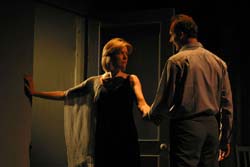
I was reading Harold Pinter these days, a favorite playwright to me, and his "Betrayal" in particular. Three people (this is the Dorian structure he prefers, A, B, C mixing and becoming the truth formula to each other) negotiate on events of betrayal. What is the correct presentation of the links among them? 1.Jerry and Robert are best friends from college, publishers of the literary magazines of their universities, colleagues later on in the publishing business. 2. Emma is married to Robert, 3. Jerry and Emma have a long affair, after she got married to Robert, and almost for most of her married life. Fine. So the issue is: when did the other part know? When did Robert know? When did Emma admit it to him? When did Jerry know that Robert knew? When did Robert admit to Jerry that he knew? When did Emma told Jerry that Robert knew? The facts are simple as that. But here again , it is the moment of admitted knowledge that makes the truth. It is not a play about betrayal as a sexual/moral violation, but a betrayal about the instance of revelation. Partial knowledge is the raw material for a multilayer betrayal, and time is its artisan. The majesty in Pinter's lines is his simple style. It goes as follows:
a. 1977: Emma and Jerry meet after long time in a pub, and they discuss the end of their affair, some two years ago. She says that she divorces Robert, and by the way she admitted to him her affair with Jerry.
b. 1977 (later): Jerry meets Robert rather anxious, to discuss or even to apologize for having an affair with his almost ex-wife. Robert says that Emma told him some four years ago, so he knew all this period that they were behaving "normal".
c. 1975: Emma and Jerry meet in their love-nest-flat. They discuss how things got different. How and why they stopped meeting. They decide to quit the flat and the relationship, to sell for "few quid" the furniture.
d. 1974: Jerry visits Robert and Emma at home. They discuss work, he talks about his overloaded schedule. Emma suffers and Robert is supportive to her.
e. 1973: Robert and Emma are in Venice. They plan a short trip. At some point, Robert says she has a letter at the poste restante, he did not pick it for her. She says that it is from Jerry. Robert knew from the handwriting. Emma admits her relationship to him and gives all the details (the flat, the duration...)
f. 1973 (later): Jerry and Emma in their flat, after her return from Venice. They are in love, she does not tell him about the revelation that took place in Venice. It shows that Jerry is not willing to change his life for being constantly with her.
g. 1973(later): Jerry and Robert meet for lunch, in an Italian restaurant. They discuss work, Venice, and Robert does not confess to Jerry that he knows.
h. 1971: Jerry and Emma in their flat-love nest. They are crazily in love. Emma is worried whether Judith (Jerry's wife) suspects anything. Jerry denies that. They admit that they are faithful to each other (in their affair.)
i. 1968: Jerry visits the newly married couple (Robert and Emma). At a moment, while heavily drunk, he has a go on her. He compliments, he proposes, he begs. She reacts quietly, reminding him of the setting in their relations. Robert comes at some point. He takes the whole thing lightheartedly and reassures Jerry about him being his most dear friend.
Hmmmmmmmmmmm... Time makes all the job. When? (and secondarily Who? What?) In retrospection all the previous certainties get dynamically undermined. The spectator wonders, trying to remember and reinterpret what he has already watched happening.
Pinter is great, and his televised speech "Art, Truth and Politics" for the Swedish Academy at the Nobel Prize Award event (December 2005) is of the strongest texts I have read during the past few years, especially when it gets aggressive towards the US policy during the last 5 decades, a policy of aggression:

'There are no hard distinctions between what is real and what is unreal, nor between what is true and what is false. A thing is not necessarily either true or false; it can be both true and false.'

I believe that these assertions still make sense and do still apply to the exploration of reality through art. So as a writer I stand by them but as a citizen I cannot. As a citizen I must ask: What is true? What is false?

Truth in drama is forever elusive. You never quite find it but the search for it is compulsive. The search is clearly what drives the endeavour. The search is your task. More often than not you stumble upon the truth in the dark, colliding with it or just glimpsing an image or a shape which seems to correspond to the truth, often without realising that you have done so. But the real truth is that there never is any such thing as one truth to be found in dramatic art.

Labels: , , , ,

Thursday, October 25, 2007

Show me your sceleton box

handcuffs, now holding time
Well... this is an awesome event I would like to attend: It takes place these days in Berlin. An exhibition of personal tokens from love stories that came to an end. Divorced, departed, alienated, after the fever of closeness. What happened to you after you "broke up", "split", "fell apart"? Everyone has to go through different paths, to come to terms with the events, the reasons of the breaking up, the precise details, the anniversaries that come and go, torturing, uninhabited, but still like long abandoned archaeological sites, "there" but not standing anymore in their vivid actuality. Apart from this difficult turning point in our private lives (on which the nation of therapists, analysts, healers, astrologists, make a fortune) there is the cruelty of the material indications of what used to be and it is not anymore. What may happen with all these gifts, the photographs, the CDs, the souvenirs? This is why some philosophers accused materiality for cruelty. The more it grows, the heavier we get. The idea of the exhibition was conceived when two Zagreb artists, Olinka Vistica and Drazen Grubisic, split up and decided to try to heal their wounds by showing in public the proofs of their finale. In Bosnia-Herzegovina the exhibition attracted many supporters. People donated 300 objects to add to the initial core of the collection. In Germany, in Berlin, already appeared 30 objects-tokens, a wedding dress, the axe that a deserted lover used for destroying the furniture of his "ex-", Valentine underwear. The experience of loss and depression is universal.
the bike he used while leaving her
The episodes which occur on the borders of private/public draw my particular attention: how the rules of making sense of private stories mix with the rhetorics of public exposure. The public sphere, expanding to the fragments of the personal territory, with the spicy curiosity of a voyeur is something common with time. Take a glimpse, for instance, at the story of the final days of Diana "the Princess of the People", or its repetition, in a more hilarious manner, with Britney Spears. Private details about the emotional life of someone on the scene, attract grave-robbers and the flash of the cameras, the pressing questions aiming at some irritated reaction, the cheap journalism of motorcycle hunting, may culminate even in tragedies.
1. A public sphere which tackles nothing big, that does not inspire and does not educate, 2. A bored, dull and mentally unmotivated public which is so much enclosed in its personal routine details, that are lived out in the way of a dramatic series, 3. Technical means which allow an easy and daily intrusion into private spaces and the publication of their finds, all of the above and other factors I cannot think of right now, contributeto this transformation of life into a daily series of "The Bold and the Beautiful" type of impression.
Come on, let us not theorize too much, fellow-voyeurs and victims/persecutors. What would you contribute to the exhibition, if it was to appear somewhere next door, or some doors further down? (Because I feel it might be different our donation in those two cases). What would I give if it was to be set in Jabal al Webdeh, what if in Thessaloniki, or Birmingham? Cigarette boxes painted by those beloved hands, a post valentine postcard (commemorating the first year of being apart), the almond tree flowers with which i was showered during some ancient spring, falling on the wooden floor and then picked carefully by the hand of the .
Why on earth have I kept all these, and many many more?

Labels: , ,

Saturday, February 24, 2007

Λέων γεγραμμένος


The Friday effect has been mild, lighter than expected, after all. The Amlak edition along with Al Waseet and Al Momtaz brought normality and the regular rhythm of breathing back to me- everything: food, suits, furniture, tanks, training benches, maids, apartments and tiles are precisely encoded in photos, so I felt the World turns round again and around its magnetic axis. Events were minimal and regular.

I wake up early; this is a shortcoming since ever, which made me a caffeine and nicotine addict. What is now needed for such a freak? Music. Today I was in the mood for Henry Purcell and, since I do not have Dido and Aeneas in compact disc, I found its cousin, King Arthur, a very weird semi opera, typical for british baroque and the atmospere of the Court. I find it amazing the construction of national identity by means of music. Arhtur, pious Britons, heathen Saxons, a blind princess, Merlin, mixing of the visible and invisible worlds (like in Shakespeare sometimes) and a story that would trouble even Spielberg. The music goes at some parts identical like in Dido, the cold song for example. One of the few things I kept listening to in Thessaloniki this time was the Cold Song with the unbelievable voice of Klaus Nomi. (Strange, both Henry and Klaus died relatively young, like wild anemones.) Then I was rushing to the bus stop and from there to the clinic. But, as the story deals with a national identity affirmation, it does not take me very high, and I think it is better this way, this very morning. Lots of paperwork.


And here are the good news I found in the Greek news: In 2008 the museum of Nikos Hadjikyriakos-Ghika will be ready. Six storeys: the galerry on the fourth, and they will display his correspondance with Seferis, Sikelianos, Elytis, Pentzikis, etc. oh Generous God! and his manuscripts. This is a good motivation to keep it up till 2008 :)). I do not recall exactly how many exhibitions of his I have attended. Some while he was still creating, and other, posthumous ones.

Three encounters influenced me deeply: two of his paintings I saw while I was 17, a big thematic exhibition at the Old Archaelogical Museum in Thessaloniki (a nice rococco mosque of the late ottoman years), in which I realized how good he was in scetching, and last summer on Hydra, a small one, like a revision, at his place of origins, in a house like his, with the landscapes he painted just appearing from the windows. It was like a revision in general for more than one thing: His art, his austere choices, my youth, my conclusions. Then we stood with Voula and Pelagia, by the canons watching the night and the dark waves in silence. Never trust lovers who give lectures from the podium of their pillow:)).

Labels: , ,