Sunday, May 02, 2010

Μεταξύ Ησιόδου και Max Weber

Στις καταστάσεις τραύματος μιλούν συχνά για τις στρατηγικές με τις οποίες επιχειρεί η ταλαιπωρημένη ψυχή να βγάλει άκρη, να φτιάξει με τα ελάχιστα έναν φράχτη πριν πηδήσει στον γκρεμό που βλέπει κιόλας ξεκάθαρα.
Εκεί επεμβαίνει η άρνηση αποδοχής, η γελοιογραφική αποτύπωση, ο εξωραϊσμός, εν γένει ό,τι κάνει το πικρό γλυκό. "Όλα μια ιδέα είναι" λοιπόν;
Παραθέτω δύο αντιδράσεις στα δραματικά νέα περί των ανακατατάξεων που διαφαίνονται στο Ελληνικόν. Γιατί το διακύβευμα δεν είναι μόνον κάποια χρήματα που, καθώς θα μας λείψουν, θα δυσχεράνουν τη ζωή μας βέβαια. Αντίθετα, είναι κι άλλα: κοινωνικά κι εργασιακά δικαιώματα, προϋποθέσεις για ατομικές και πολιτικές ελευθερίες, το δικαίωμα στην ασφάλιση, την υγειονομική περίθαλψη, τη συμμετοχή σε πολιτιστικά αγαθά, τέτοια πράγματα. Περισσότερο απ' όλα ξεβολεύει η συνειδητοποίηση ότι η ζωή που βίωνε το υποκείμενο ως κανονική ήταν μια μασκαράτα, κι ότι μετά το Τριώδιο έρχεται η Σαρακοστή. Δεν έχω ψευδαισθήσεις για τις υποτιθέμενες αρετές της πενίας, για αναδιανομή και δικαιοσύνη. Κανείς δε φαίνεται να πιστεύει ότι υπάρχει κολυμβήθρα του Σιλωάμ για τους πολιτικούς και τις λίγες χιλιάδες τσόγλανους προστατευόμενους. Εννοώ μια κολυμβήθρα Σιλωάμ για την πολιτεία και το ήθος τέτοιων ανθρώπων. Έτσι κι αλλιώς, φρόντισαν αυτοί και μοναστήρια να ανακαινίσουν ώστε ως ανακαινιστές να βρουν το πορθμείο για τη θεϊκή νήσο των Μακάρων και πισίνες να φτιάξουν προς αναψυχήν και τέρψιν τόσο στο σπίτι στην πόλη όσο και στα εξοχικά.
Σε άρθρο των ΝΕΩΝ αναφερόμενο σε δημοσίευμα του γερμανικού Spiegel, ιδού πώς αντέδρασε ο αναγνώστης με το προσωνύμιο "Αχαιός":

"Ελπίζω να μείνουν για πάντα και να μην φύγουν ποτέ μπάς και γίνουμε ποτέ σύγχρονο κράτος και πάψουμε να είμαστε μπανανία.
Οπως όλοι καταλαβαίνετε, μόλις κάνουν ότι φύγει το ΔΝΤ οι απατεώνες και άχρηστοι πολιτικοί που έχουμε στην Ελλάδα θα υποκύψουν στους εργατοπατέρες με αποτέλεσμα πάλι να χρεοκοπήσουμε κυρίως λόγω των Δημοσίων Υπαλλήλων και της ρεμούλας που παίζει στο Δημόσιο., Οπότε, όχι 10 χρόνια επιτήρηση, 100 χρόνια επιτήρηση και να μην φύγει ποτέ το ΔΝΤ απο δώ."

Με λίγα λόγια, "σφάξε με Αγά μ', ν' αγιάσω". Παράξενο, λέω, όμως που προηγούμενες επιτηρήσεις δεν οδήγησαν σε χρηστή διοίκηση, μα σε περισσότερη απατεωνιά με συνεργασία. Είναι αφέλεια συχνή στην κοινή γνώμη η φανταστική υπόθεση ότι κάπου στη Δύση ζει ένα είδος αγνών πουλιών, καπιταλιστών μα προτεσταντών, άτεγκτων μα αγνών που θυσιάζεται για την ιδεώδη λειτουργία του συστήματος. Όπως τους υπαινίσσεται ο Max Weber. Τέτοιο είδος δεν υπήρξε ποτέ. Τα συστήματά τους ήταν αποδοτικά και σώρευσαν πλούτο γιατί ρήμαξαν τις αποικίες, κατέκλεψαν τις ζωές των Ευρωπαίων δύο φορές στον 20 ο αι., πούλησαν οπλισμό και προστασία νταβατζή ήδη από τον 19 ο αι., πλούτισαν με τις πρώτες ύλες άλλων φτωχών χωρών που τις αγόρασαν με όρους διομολογήσεων.
Έπειτα είναι και οι λογοτέχνες, οι δημοσιολόγοι και οι μεταξύ τους επιμειξίες.
Χαριτωμένα κείμενα, νοσταλγικά. Αφορούν την ανάμνηση της παιδικής ηλικίας και τις ενθυμήσεις από κουτσουρεμένες αφηγήσεις των άλλων. Σημειώνει, επί παραδείγματι, ο Γιάννης Ξανθούλης τα παρακάτω:

"Να ξαναγίνουμε φτωχοί. Όπως ήμασταν πάντα. Όπως οι ήρωες των παλιών αναγνωστικών που οι γιαγιάδες έμοιαζαν με γιαγιάδες κι όχι με συνταξιούχες πόρνες. Όπου οι μπαμπάδες επέστρεφαν το μεσημέρι για να καθίσει ΟΛΗ η ελληνική οικογένεια στο τραπέζι και να φάει το σεμνό φαγητό -όσπρια πεντανόστιμα και ζαρζαβατικά με μαύρο ψωμί μοσχοβολιστό- ενώ η γάτα και ο σκύλος περίμεναν στωικά να 'ρθει η σειρά τους ... Να ξαναγίνουμε φτωχοί όπως ήμασταν πριν σαράντα και πενήντα χρόνια. Τότε που ονειρευόμασταν εν μέσω γκρι, μπλε και μπεζ χρωμάτων, τότε που καμιά Ελληνίδα δεν φιλοδοξούσε να γίνει ψευδοξανθιά, τότε που η λάσπη κολλούσε συμπαθητικά στα παπούτσια μας και οι αυθεντικοί ζήτουλες βρίσκονταν έξω απ' τις εκκλησιές περιμένοντας το τέλος της λειτουργίας και του μνημόσυνου.
Να ξαναγίνουμε φτωχοί πλην τίμιοι, χωρίς κινδύνους να ξεστρατίσουν οι αρχιμανδρίτες προς την ψηφιακή παιδοφιλία. Να βρούμε ξανά τις σωστές μας κλίμακες χωρίς αγωνία παρκαρίσματος και παχυσαρκίας. Να ξαναβρούμε τη γεύση του «μπατιρόσπορου», των ελαχιστοποιημένων αναγκών, να ανακαλύψουμε εκ νέου τον ποδαρόδρομο και το συγκινητικό μοντέλο της «γυναίκας της Πίνδου». Μόνο με τέτοιες ηρωικές διαδρομές ενδεχομένως να ακυρώσουμε το κόμπλεξ μας έναντι του Μπραντ Πιτ και της Ναόμι Κάμπελ. Να ξαναβρούμε -γιατί όχι- και τους παλιούς καλούς εχθρούς (κυρίως από τα βόρεια) που σήμερα τους έχουμε σκλάβους στα παβιγιόν μας. Να ξετρελαθούμε από την επικοινωνιακή μας υστερία με τα σιχαμένα κινητά τηλέφωνα που κατάργησαν κάθε έννοια ιδιωτικής ζωής. Να σκάψουμε στις αυλές -όσοι έχουν αυλές- και να κάνουμε παραδοσιακούς ασβεστόλακκους για να ασπρίζουμε τα δέντρα έτσι για καλαισθησία και υγεία. Να βρούμε πάλι τη σημασία του χώματος καταργώντας το καυσαέριο του επάρατου τρέχοντος πολιτισμού. Να εφεύρουμε τις παλιές νοσοκόμες που σέρνονταν από σπίτι σε σπίτι ρίχνοντας ενέσεις πενικιλίνης στα οπίσθια ολόκληρου του Έθνους. Να προσδιορίσουμε ξανά την ντροπή και τον «σεβασμό» προσέχοντας το βλακώδες λεξιλόγιο των τέκνων μας. Επιτέλους, όποιο τέρας βρίζει ή χρησιμοποιεί την πάνδημη και πολυμορφική λέξη «ΜΑΛΑΚΑΣ» πάνω από εκατό φορές την ημέρα να το μπουκώνουμε με «κόκκινο πιπέρι εξόχως καυτερό», όπως τον καιρό της εξαίρετης φτώχειας μας . Να μάθουμε να χρησιμοποιούμε τα κουλά μας χέρια σε δουλειές που σήμερα δίνουμε του κόσμου τα λεφτά, όπως μεταποίηση ρούχων, αλλαγές γιακάδων στα πουκάμισα, καρικώματα στις κάλτσες, υδραυλικές και σχετικές εργασίες. Να απαγορευτεί διά ροπάλου το γκαζόν που για μας τους πρώην φτωχούς δεν σημαίνει απολύτως τίποτα. Στη θέση του να φυτευτούν λαχανικά ή και οπωροφόρα για να μην καλοσυνηθίζουμε την κάστα των μανάβηδων. Κάποτε ο μαϊντανός, τα κρεμμύδια και τα σκόρδα ήταν τα βασικά καλλωπιστικά των κήπων μας . Να επανακτήσουμε το κύρος μας, χρησιμοποιώντας βέργες κι ό,τι τέλος πάντων απαιτούσε ο βασικός σωφρονιστικός κώδικας τα χρόνια της περήφανης ανέχειας ... Σταματήστε τις ψυχολογίες και τις παραφιλολογίες για τα «τραύματα» των παιδιών. Μόνο λύσεις γήινες και πρακτικές -χωρίς ενστάσεις από τον Ρομπέν της ευαισθησίας, τον ΣΥΡΙΖΑ- θα αποκαταστήσουν την τρέλα και το χάος που υπαινίσσονται οι στατιστικές. Να θυμηθούν οι Νεοέλληνες πως προέρχονται απ' τον Μεγαλέξανδρο, από τον Μιλτιάδη, τον Αριστείδη και προφανώς απ' τον... Αλκιβιάδη, πράγμα που σημαίνει ότι μπορούν να βάλουν σε ενέργεια τον «δίκαιο θυμό» αν συμπέσουν με ληστές τραπεζών, περιπτέρων, σούπερ μάρκετ και κοσμηματοπωλείων. Κανένας δισταγμός. Τα παλιά χρόνια για ψύλλου πήδημα σε μπαγλάρωναν. Θυμήσου και κόψ' τους τα χέρια ή και τα αχαμνά. Επιτέλους ας σταματήσουμε την ευρωπαϊκή μας ψυχοπάθεια ... ΠΟΤΕ κανένας Έλληνας δεν έγινε σωστός Ευρωπαίος. Ούτε καν ο Αβραμόπουλος ούτε καν ο Σημίτης και άλλοι τέτοιοι που μου διαφεύγουν. Απ' τον καιρό που σταματήσαμε να θυμώνουμε σωστά, την πατήσαμε. Σταματήστε το «ντόπινγκ» με το τσουλαριό των λαϊκών ασματομουλάρων. ΠΟΣΟΥΣ ΠΙΑ ΤΡΑΓΟΥΔΙΣΤΕΣ ΧΩΡΑ Η ΕΛΛΑΣ, κύριοι καναλάρχες της πλάκας; Δεν είναι καιρός να ξεβρωμίσει ο τόπος απ' τους εκφραστές του τραγουδιστικού Κάμα Σούτρα; ΠΟΙΟΣ θα μαζέψει τις ελιές στα περιβόλια όταν ο κάθε πικραμένος ονειρεύεται να γίνει αφίσα στη Συγγρού; Ποιος θα καθαρίσει τη Συγγρού απ' το αίσχος της καψουρικής ταπετσαρίας, κύριοι δήμαρχοι; Οι τραβεστί; Οι καημένες οι τραβεστί έχουν άλλες υποχρεώσεις ... Μη φοβάστε τη φτώχεια. Η πατρίδα μας είναι ευλογημένη έστω κι αν δεν παράγει λαμαρίνες αυτοκινήτων ή καλής ποιότητας νάρκες και όπλα για τριτοκοσμικούς. Θυμηθείτε την ευλογία του ελαιόλαδου, της κορινθιακής σταφίδας, του χαλβά Φαρσάλων, των εσπεριδοειδών, της σαρδέλας και των λατρεμένων ραδικιών. Λάδι, χόρτα, ελίτσες, λίγο τυρί και ψωμί ζεστό, να φρεσκάρουμε στο μνημονικό μας το παλιό αναγνωστικό του Δημοτικού. Το ξέρω πως είναι ζόρι να κόψουμε το σούσι απότομα, όμως ήρθε ο καιρός να αναβιώσουμε την όπερα της πεντάρας, της δεκάρας και των άλλων χρηστικών μας αξεσουάρ. Μια δοκιμή νομίζω πως θα μας πείσει ... ΖΗΤΩ Η ΕΛΛΑΣ και ο θεός των μικρών πραγμάτων μαζί μας".

Έκπληκτος διάβαζα το κείμενο αυτό που μου απέστειλε φίλη τις προάλλες. Παίζοντας με τις λέξεις, βάζοντας στο σέικερ ακραίες εικόνες ανάμεικτες, δημιουργεί ο λογοτέχνης ευχάριστο σύννεφο. Αυτή είναι η μερίδα του στο λόγο. Κάτι θυμόμαστε από τα σχολικά αναγνωστικά, κάπως ωραίο ήταν το φαγητό στα οικογενειακά τραπέζια των παιδικών χρόνων, κάπως πιο λιγνοί ήταν οι άνθρωποι κι οι φιγούρες τους γλυκύτερες. Μα από εκεί μέχρι την εξιδανίκευση της φτώχειας ως βασικού φυλετικού χαρακτηριστικού ακμής και προκοπής υπάρχει πολύς δρόμος. Και ανησυχώ μήπως τον διαβούμε όλον, για να θυμηθούμε ότι ούτε τα κλασσικά δημιουργήματα, ούτε τα βυζαντινά ούτε τα νεοκλασσικά ούτε τα μοντέρνα διαμάντια έγιναν χάρη στην πενία.
Και, εν τέλει, σκέφτομαι το ακόλουθο: για να βρεις το χαμένο δήθεν μέτρο των πραγμάτων, προϋπόθεση είναι να έχεις συνειδητοποιήσει πως βρίσκεσαι πια εκτός μέτρου. Αμφιβάλλω αν ο νεοέλληνας συμπολίτης είχε την εντύπωση ότι κινούνταν δυσαρμονικά κι εκτός μέτρου. Τίποτα δεν τον είχε ενημερώσει σχετικά: ούτε η βλακώδης εγχώρια ειδησεογραφία, ούτε η λειψή του μόρφωση, ούτε η δημόσια προστασία από όσα πρόβαλλαν οι διαφημιστές και οι πράκτορες των Τραπεζών που τον μάγευαν τηλεφωνικώς σαν τις κυρίες που λάνσαραν Tupperware στο τέλος της εποχής που νοσταλγεί κατ' εξακολούθηση ο Γ. Ξανθούλης.

Labels: , , ,

Friday, October 03, 2008

Γιορτή στο τέλος της


Ποιας γιορτής ποιο βράδιασμα
Ποια άχνη δήθεν ζάχαρη στρωμένη
Ποια χαρακιά στο πινάκιό μου ανέλπιστη
να τρικυμίζει λίγο,
όσο στη γεωμετρία επιτρέπεται,
εκείνο των περιστάσεών μου το ερυθρόμορφο

Μαζεύτηκαν από κάτω οι γνωστοί αγνώριστοι
Από άκρη σε άκρη τζαμωτό
Απ'την αρχή ως το πέρας η φωνή τους

Ποιας γιορτής ποιο νύχτωμα
Ποιες φωτοβολίδες μακριά καταιγισμός και κρότος
Ποια τα παράπονα ευχές που άθροιζαν τα χρόνια

Έγραφε πάντα νύχτα ο λογιστής απέναντι
σκότος βαθύ
Δεν ξέρω γιατί χρειάζεται κλεφτο-
φάναρο σε όσα υπολογίζει η μνήμη

Ποιος ταχυδρόμος φέρνει
με λίγη καθυστέρηση ποιο νεύμα

ο παλαιοημερολογίτης

Labels: ,

Wednesday, March 19, 2008

Ενός λεπτού σιγή

Με τον Χριστιανόπουλο δεν έχω πάντα τις καλύτερες σχέσεις. Είναι περίοδοι που διαβάζω τα μικρά του, αυτές τις όμορφες εκδόσεις της Διαγωνίου, και χάνομαι στις προσωπικές ιστορίες του. Άλλα χρόνια, δεν τις αντέχω αυτές τις ίδιες ιστορίες. Άλλοτε δεν ξέρω να αποφασίσω αν μου αρέσουν τα πεζά του περισσότερο από τα ποιήματα ή μήπως το αυτοβιογραφικό του εκείνο που άκουγα στο ραδιόφωνο κι αργότερα το βρήκα σε βιβλίο (εκείνην την υπέροχη σειρά -πώς την έλεγαν; "Εν Θεσσαλονίκη";- αυτοβιογραφικού πόνου που είχε ετοιμάσει ο 9,58 στη Θεσσαλονίκη και που απορώ γιατί δεν την ψηφιοποιούν να την αποστείλουν στα σχολεία, μήπως και φωτιστεί κανένα παιδί από τις δυνατότητες της γλώσσας).
Κι ήρθε η ιδέα του Επενδυτή να ξαναβγάλει, αυτήν τη φορά σε δίσκους ακτίνας, τις αναγνώσεις της "Λύρας". Μάζεψα ό,τι πρόλαβα στο σύντομο ταξίδι του χειμώνα και τα άκουσα εδώ, ενώ έξω από το παράθυρό μου τα παιδιά παίζουν μπάλα και προτρέπουν ο ένας τον άλλο με μεγαλόφωνα "Γιάλλα Φαρίιντ", "Χοτ Μουχάνναντ". Η φωνή, αυτό που λέω "αντηχείον της ψυχής", αυτό που με κάνει δύσκολο να μιλήσω στο τηλέφωνο σε ανθρώπους που δεν ξέρω... Ή, πάλι, με καταθλίβει αμέσως, αν ακούσω έναν τόνο απροσδόκητο, και βιάζομαι να αποτελειώσω την κουβέντα και να μπω δικαιωματικά στο χάος του εσωτερικού ψιθυρίσματος. Έτσι ξανάκουσα τη φωνή του Χριστιανόπουλου που, από μόνη της, δεν μου αρέσει. Αλλά... Έτσι όπως διάβαζε τους τίτλους των συλλογών και των ποιημάτων, είχε μια ελάχιστη παύση κι ένα θόρυβο σα να γύριζε μέσα του σελίδες και όλο πιο βαθειά να βυθιζόταν στον Ανυπεράσπιστο Καημό. Σα να έλεγε "Ωωωχ βάσανα, το έγραψα κι αυτό. Φτάνει πια." Και μου φάνηκε τόσο αληθινή ώστε ξεδιάλεξα δυο-τρία ποιήματα για τους φοιτητές του δεύτερου επιπέδου, κι έτσι λογαριάζω να εμπλουτίσουμε φέτος το ανθολόγιό μας, με φωνές που εκμυστηρεύονται. Τι διάλεξα; Κάτι που να έχει και λίγη μουσική ποικιλία, από εκείνα που ο Χατζιδάκις μελοποίησε.
Παραδείγματος χάριν:
Ντίνος Χριστιανόπουλος (2)

Ενός λεπτού σιγή

Εσείς που βρήκατε τον άνθρωπό σας

κι έχετε ένα χέρι να σας σφίγγει τρυφερά ,

έναν ώμο ν'ακουμπάτε την πίκρα σας,

ένα κορμί να υπερασπίζει την έξαψή σας,


κοκκινίσατε άραγε για την τόση ευτυχία σας,

έστω και μια φορά;

είπατε να κρατήσετε ενός λεπτού σιγή

για τους απεγνωσμένους;

σφίγγω- clasp, grasp, grip, τρυφερός-tender, ώμος-shoulder, ακουμπάω- touch, let aside, πίκρα- bitterness, sorrow, κορμί=σώμα, υπερασπίζομαι-defend, έξαψη-excitement,
κοκκινος>κοκκινίζω, έστω-
let it be, even , κρατάω- keep, hold, (κρατάω ενός λεπτού σιγή: observe one minute's silence), απεγνωσμένος-desperate

In this poem, Hristianopoulos, addresses the privileged plural subject "Εσείς", the ones who succeeded in finding their alter ego, their missing halves according to Aristophanes' account about love as it appears in Plato's Symposium. The tone suits the role of the Prosecutor who talks on behalf of the less fortunate.

Exclusion, despair, grievances (personal exclusion, etc, this is) are usual themes in his poetry. From another point of view, he does nothing unusual, given the inner rhetoric that develops each one of us, dialogs and monologues of justification, excuse, acceptance and glorification of the subject.

--Η Ραφήφ στράφηκε τότε και μου είπε, για να ζητά ενός λεπτού σιγή, θεωρεί αυτούς τους ανθρώπους και τον εαυτόν του πεθαμένους. Πεσόντες, της λέω.

Νομίζω ότι ειρωνικά είχε πει ο Δημαράς πως η βασιλική οδός της σύγχρονης πεζογραφίας μας περνάει από τη Θεσσαλονίκη. Κι όμως, ο Ιωάννου, ο Χριστιανόπουλος, ο Καζαντζής, πράγματι υποδεικνύουν μια βασιλική οδό: την εξομολόγηση ως το μεγάλο θέμα, όχι ως μέθοδο ή παρενθετικό πείραμα.

Labels: , , ,

Monday, November 12, 2007

Fixation in Progress...

R.A., for the needs of an assignment, decided to interview me, I have no idea why:)... She sent me some 19 questions, which put me in a big trouble of personal interpellation. For five days I kept asking myself the same questions, and the more lengthy answers I was typing in my mind, the deeper I was entering a continent of memory, unfinished business and a great big hesitation concerning the future tense, both simple and continuous. Somehow, I recalled 1993 and our "Sexuality Group" meetings (a reading and writing group) in Birmingham with Richard Johnson being the discreet hero of acrobatic balance.
En voila a small sample (in the end I picked only 15 questions to answer, not daring for more.)

1. How did you know that education is what you want to do in your life?


This is an insight that you gain both suddenly and in the long run. You complete an hour’s teaching and suddenly you just feel happy and satisfied. You take pride in having managed to complete your planning: to transfer the specific amount of information, to leave space for interaction with the students, to suggest further reading, to keep a positive spirit in class, balancing between the target (information-knowledge) and the condition (conversation, fun, getting more people involved with the subject, you and each other) without feeling pressed with side issues of authority. Concerning the insight that one gains in the long run, let me mention that at the
University of Jordan I have been teaching the same more or less subjects for the last eleven semesters. To me, it has never been the same. I imagine myself translating the same book for 11 times and I experience vertigo. Even the third proof reading of a translated text starts getting heavy on me.

2. How do you view the process of teaching?


You know perhaps the fundamental concept of dialectics. How two different positions/subjects enter the process of dialogue (let us name them A and B), ready to prove, maintain, modify and change through interaction. It is a concept that appears early in Plato’s texts (4th century B.C.) and the manuals of Rhetoric. Here, I refer to Plato’s Dialogues, Socrates starts discussing serious issues with famous and less famous counterparts on the basis of openness and genuine respect. The success of his pedagogic approach would finally rely on forming a third position, which is neither A, nor B, not even A+B, but it is a brand new C>A+B. The process of teaching is one of the most delicate achievements of human mind. Normally we learn the basics by imitating, watching our parents, siblings, and our micro-environment. Teaching, especially academic teaching should be a step beyond this “natural” process. It can or, rather, should be the replacement of imitating an action with negotiating about the meaning. This is the difference between “doing” and “making sense of what we are doing”. Strangely enough though, you might have noticed that, to an alarming extent, societies and economies ask for practitioners instead of thinkers.

3. In your Greek I and II classes, you don't only teach language but you also try to familiarize you students with the culture as well. Why do you think this is important?


This approach developed more with time and it came along with my sense of pragmatism and my theoretical approach to language. I realized pretty early that two semesters of learning Greek language, in a program of three hours per week (which is the normal maximum for a student of U.J.) would not suffice in building up an adequate capacity of communication or the acquisition of an extensive and at the same time active vocabulary. Please note that English for example is taught in Jordanian schools, colleges and institutes for several years, the language is omnipresent in the daily life of an average student through TV, radio, songs or cinema and still the results are not always satisfactory. Just imagine what the results would be for a two-semester course, for a language that is not extensively used in Jordan (except within the relatively small Greek community in Jordan and among the Jordanian alumni of Greek Universities, doctors and engineers). The dilemma for the instructor is either to panic and to try to transfer few extra words and phrases or, to entrust the students with keys for understanding another culture, based on language but taking also the necessary detours in history, music, literature, and sociology. I believe that the second approach offers some advantages. First of all, it deals with language in its real dimensions: language is culture, insight, a treasury of time, difference and similarity. Secondly, by knowing more than some verbs and nouns, the student might feel comfortable to revisit this material, get more information, and personalize his/her learning experience. I find it sad anyway, for someone to know some French for instance, but not to know anything about the country, the history and the people who use the language.

4. Do you think people value education enough in Jordanian society?


Unfortunately Jordanian youth is more enthusiastic about cars, fancy looks, and the persistent daydreaming of personal paradises which would include villas, cars (again) and the exciting jealousy towards a tycoon. It is a massive and typical American soap-opera fantasy. Many boys feel shy to carry books or even allow a notebook to reveal that they are currently students. And several girls care more about their mobile and tiny little leather bags. I hope that fashion will soon dictate bigger shapes and models. I witness complaints about not finding good and up-to-date books, but this is simply not true. Not only there are few good bookshops in
Amman, but I also see how prompt the managers of such places are in asking my advice and suggestions concerning new titles. I believe that the older generation values education more: their chances to get good academic instruction were slim and on many occasions this demanded an adventure abroad which they could not afford. I see parents investing most of their savings in the effort to provide their children with good education. This is daily life heroism. I definitely hope that soon the time will come for the young generation to realize that education is an absolute social value and not a temporary burden. And I wish that all these talents, skills and inherited kindness that I see around, will be invested in picking the suitable specialization (according to the character, the gradually built-‘nature’ of each one) and developing it into a real passion. Only people who find a positive outlet for their creativity and carve the path to communicate their dreams can work wonders and push their society one step forward. Such people inspire others and, eventually, push academia to produce more, and to replace the ivory tower concept with a more pleasurable one.

5. How would you describe your experience in Jordan?

It has been an experience that helps me a lot. I use the present tense because the process is on-going and dynamic. I have not experienced any kind of cultural shock while being in Jordan. By observing the details in behaviors, by asking, reading and learning, I understood better this part of the world, the historical process of transformation, and dealing with a glorious and heavy past under the constellation of contemporary circumstances. The question of transformation has been answered also in various ways by the Greek nation, policy-makers and intellectuals during the last 150 years and with similar features. How does one make sense of him/herself during the transitional period of westernization? What is to be maintained? How does it feel to be the object of orientalist approaches which affect your way of making sense of it all? How does one deal with the refugee identity, the traumatic memory of loss and the pragmatism of “life carries on”? And what about this old, magical, calligraphic, poetic and difficult language? What do you make out of it? You see, my Jordanian experience is an experience of question marks. It is also an experience of faces (people who are dear to me), of houses that they opened the front door for me and made me feel they are homes.

6. What do you like most about Jordan?

The genuine people I have met; and those out of them who honor me by being my friends. I would have chosen them in any geographical setting. I also like being in a taxi listening successively to patriotic songs, Fairooz and Umm Kalthum, dedicated by some Fadi to his schoolmates, by Abu Eyas to his son who studies in Irbed and by some old lady to her family abroad.

7. Who is the main influence in your life? Why?

Nobody has influenced me more than Cavafy, the Alexandrian Greek poet (1863-1933). His work was a strong arm that embraced me on the right moment. Since my adolescence (I mean for the last twenty five years almost) he has been my most stable companion. Cavafy broke in me the mirror of that so called and so much celebrated “simplicity”. The way he negotiates with the notions of memory and identity, and the way he implements his aesthetics have been training me in a worldview that possesses many features of post-structuralism. In this world, a world that stands beyond “simple” binary models, one never graduates, never has the final ‘summary-conclusion’ part typed; so one is allowed to remain playful and wondering. Perhaps, to put it this way, I retrospectively justify the reprimand of the Egyptian priest to Herodotus “Greeks, you remain children indefinitely”. Enshallah.

8. What is one important thing you would like to accomplish in the future?


Writing “it” all down, this would be my most far reaching accomplishment. By “it” I mean the numerous question marks I have gathered (and you see that they are a bit more than few), the instances and the periods, the tree and the forest.

Labels: , ,

Monday, October 29, 2007

Show me again 'n' again

I have noticed that we get either dramatically silent or dramatically eloquent in exposing "truth" and the "politics of truth" about our story, momentarily paused and interpreted retrospectively for others. Defensive, cryptic, too subjective or too theoretical. As if we are a specimen of an extinct species, giving its final testimony. And indeed, we are, but it just happens so that everyone else is too. This note follows the logic of the previous post and will be reworked in Greek under the category "Structure- in numerous parts".
What we show, let it be the skeleton box, the hidden garden, the window as a frame for an instance of life, or as a frame for the curtain that depicts a scene of life, or conceals a whole perspective of life, is a lot of quicksand. Selective and partial as we are, we can easily shake the impression of others. Almost no one knows us, and we know almost no one. "I know him": what a pompous overstatement, after all...

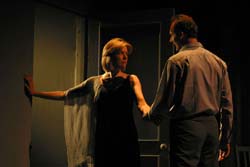
I was reading Harold Pinter these days, a favorite playwright to me, and his "Betrayal" in particular. Three people (this is the Dorian structure he prefers, A, B, C mixing and becoming the truth formula to each other) negotiate on events of betrayal. What is the correct presentation of the links among them? 1.Jerry and Robert are best friends from college, publishers of the literary magazines of their universities, colleagues later on in the publishing business. 2. Emma is married to Robert, 3. Jerry and Emma have a long affair, after she got married to Robert, and almost for most of her married life. Fine. So the issue is: when did the other part know? When did Robert know? When did Emma admit it to him? When did Jerry know that Robert knew? When did Robert admit to Jerry that he knew? When did Emma told Jerry that Robert knew? The facts are simple as that. But here again , it is the moment of admitted knowledge that makes the truth. It is not a play about betrayal as a sexual/moral violation, but a betrayal about the instance of revelation. Partial knowledge is the raw material for a multilayer betrayal, and time is its artisan. The majesty in Pinter's lines is his simple style. It goes as follows:
a. 1977: Emma and Jerry meet after long time in a pub, and they discuss the end of their affair, some two years ago. She says that she divorces Robert, and by the way she admitted to him her affair with Jerry.
b. 1977 (later): Jerry meets Robert rather anxious, to discuss or even to apologize for having an affair with his almost ex-wife. Robert says that Emma told him some four years ago, so he knew all this period that they were behaving "normal".
c. 1975: Emma and Jerry meet in their love-nest-flat. They discuss how things got different. How and why they stopped meeting. They decide to quit the flat and the relationship, to sell for "few quid" the furniture.
d. 1974: Jerry visits Robert and Emma at home. They discuss work, he talks about his overloaded schedule. Emma suffers and Robert is supportive to her.
e. 1973: Robert and Emma are in Venice. They plan a short trip. At some point, Robert says she has a letter at the poste restante, he did not pick it for her. She says that it is from Jerry. Robert knew from the handwriting. Emma admits her relationship to him and gives all the details (the flat, the duration...)
f. 1973 (later): Jerry and Emma in their flat, after her return from Venice. They are in love, she does not tell him about the revelation that took place in Venice. It shows that Jerry is not willing to change his life for being constantly with her.
g. 1973(later): Jerry and Robert meet for lunch, in an Italian restaurant. They discuss work, Venice, and Robert does not confess to Jerry that he knows.
h. 1971: Jerry and Emma in their flat-love nest. They are crazily in love. Emma is worried whether Judith (Jerry's wife) suspects anything. Jerry denies that. They admit that they are faithful to each other (in their affair.)
i. 1968: Jerry visits the newly married couple (Robert and Emma). At a moment, while heavily drunk, he has a go on her. He compliments, he proposes, he begs. She reacts quietly, reminding him of the setting in their relations. Robert comes at some point. He takes the whole thing lightheartedly and reassures Jerry about him being his most dear friend.
Hmmmmmmmmmmm... Time makes all the job. When? (and secondarily Who? What?) In retrospection all the previous certainties get dynamically undermined. The spectator wonders, trying to remember and reinterpret what he has already watched happening.
Pinter is great, and his televised speech "Art, Truth and Politics" for the Swedish Academy at the Nobel Prize Award event (December 2005) is of the strongest texts I have read during the past few years, especially when it gets aggressive towards the US policy during the last 5 decades, a policy of aggression:

'There are no hard distinctions between what is real and what is unreal, nor between what is true and what is false. A thing is not necessarily either true or false; it can be both true and false.'

I believe that these assertions still make sense and do still apply to the exploration of reality through art. So as a writer I stand by them but as a citizen I cannot. As a citizen I must ask: What is true? What is false?

Truth in drama is forever elusive. You never quite find it but the search for it is compulsive. The search is clearly what drives the endeavour. The search is your task. More often than not you stumble upon the truth in the dark, colliding with it or just glimpsing an image or a shape which seems to correspond to the truth, often without realising that you have done so. But the real truth is that there never is any such thing as one truth to be found in dramatic art.

Labels: , , , ,